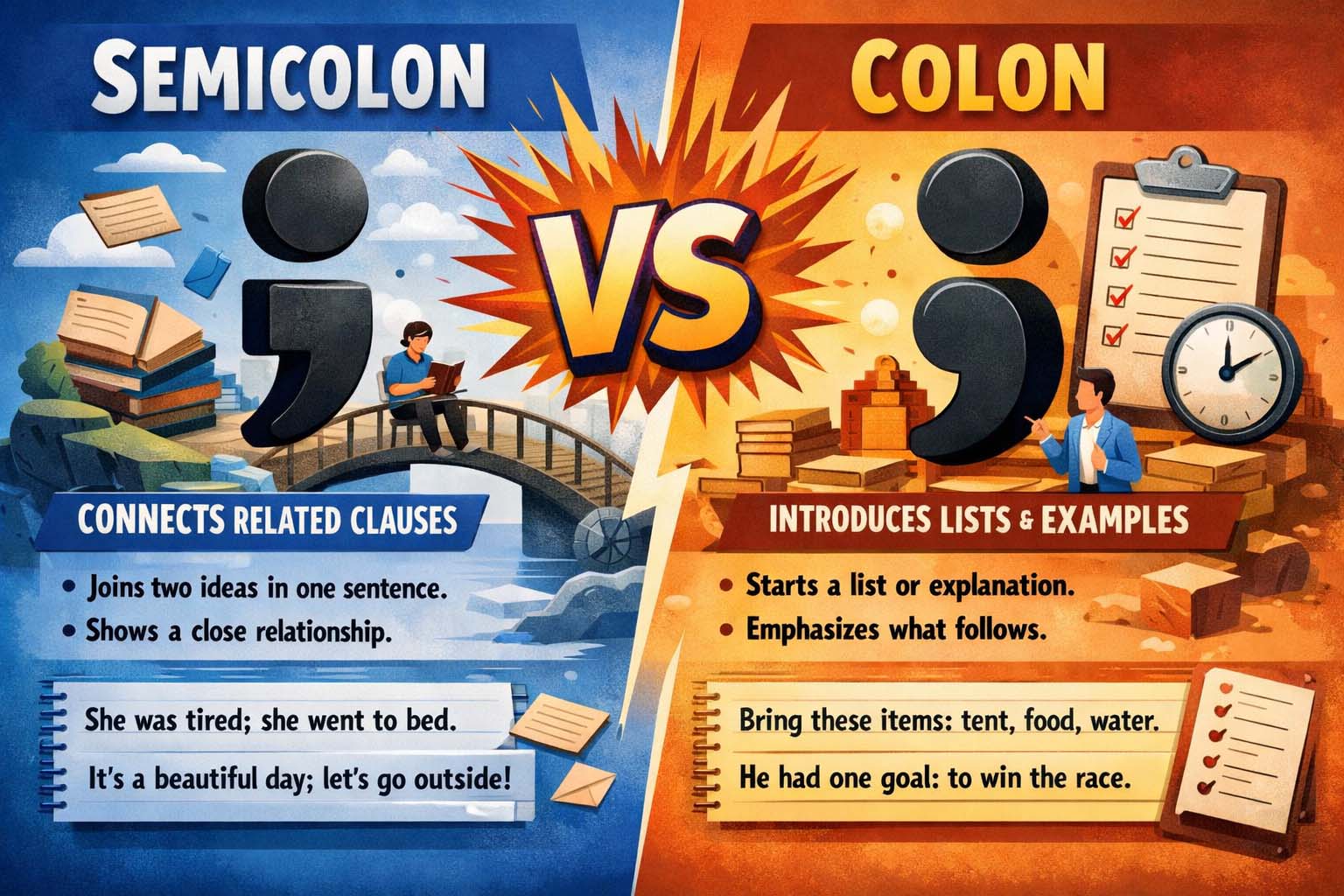
Understanding semicolon vs colon is essential for clear and professional writing. These two punctuation marks often confuse students, bloggers, business writers, and even native speakers. Although semicolons and colons may look similar, they serve very different purposes in grammar.
Knowing when to use each mark can improve sentence flow, readability, and overall writing quality. Whether you are writing essays, emails, reports, or online content, mastering semicolon vs colon helps your message sound polished and correct.
This guide explains the difference between semicolons and colons in simple language with examples and practical tips.
What Is a Semicolon?
A semicolon ( ; ) is punctuation used to connect closely related independent clauses or to organize complex lists.
Example:
- I wanted to go outside; it was raining heavily.
- She studied all night; therefore, she passed the exam.
In both examples, the semicolon joins two complete thoughts that are related.
What Is a Colon?
A colon ( : ) introduces information. It signals that something important follows, such as a list, explanation, quote, or example.
Example:
- Bring these items: passport, wallet, and phone.
- He had one goal: success.
A colon creates expectation and directs attention to what comes next.
Semicolon vs Colon: Main Difference
The simplest way to understand semicolon vs colon is this:
- Semicolon = joins related complete ideas
- Colon = introduces something new after a complete statement
Quick Comparison:
| Punctuation | Main Use |
|---|---|
| Semicolon ; | Connect related sentences |
| Colon : | Introduce lists, explanations, examples |
If you remember this rule, punctuation becomes much easier.
When to Use a Semicolon
1. Join Two Related Independent Clauses
Both sides must be complete sentences.
- The store was closed; we returned home.
- She loves reading; he prefers movies.
2. Before Transitional Words
Words like however, therefore, moreover, nevertheless often follow semicolons.
- He trained daily; however, he lost the match.
- I was tired; nevertheless, I kept working.
3. In Complex Lists
This improves clarity.
When to Use a Colon
Use a colon after a complete sentence when introducing more information.
1. Introduce a List
- I need three groceries: milk, bread, and eggs.
2. Introduce an Explanation
- She knew the truth: honesty matters.
3. Introduce a Quote
- The teacher said one thing: “Stay focused.”
4. Emphasize a Conclusion
- There was only one option: leave immediately.
Common Mistakes in Semicolon vs Colon
Many writers misuse these punctuation marks. Here are common errors.
Mistake 1: Colon After Incomplete Sentence
Incorrect:
- My favorite foods are: pizza, pasta, and rice.
Correct:
- My favorite foods are pizza, pasta, and rice.
OR - I enjoy many foods: pizza, pasta, and rice.
The phrase before the colon should be complete.
Mistake 2: Semicolon With Incomplete Clause
Incorrect:
- Because it rained; we stayed inside.
Correct:
- It rained; we stayed inside.
Each side of a semicolon should stand alone.
Semicolon vs Colon in Academic Writing
Proper punctuation is especially important in essays and reports.
Semicolons Help With Flow
They connect related ideas without creating choppy short sentences.
- Research was limited; more studies are needed.
Colons Help With Structure
They introduce definitions, lists, and key points.
- The study found three results: growth, efficiency, and profit.
Using punctuation correctly can improve grades and readability.
Semicolon vs Colon in Business Writing
Professional emails and reports benefit from punctuation clarity.
Email Example:
- Please complete these tasks: review data, send invoice, confirm meeting.
Report Example:
- Sales increased in every region; profits also improved.
Strong punctuation makes writing concise and polished.
Easy Memory Trick
If you struggle with semicolon vs colon, use this memory trick:
- Semicolon = Similar thoughts side by side
- Colon = Comes before details
This quick rule helps during editing.
More Examples of Semicolon
- I enjoy coffee; my sister prefers tea.
- He apologized; she accepted.
More Examples of Colon
- She packed everything needed: shoes, clothes, and toiletries.
- There is one lesson here: patience wins.
- The answer is simple: practice daily.
Can You Replace Them With Commas?
Sometimes writers overuse commas instead of semicolons or colons.
Incorrect:
- I was hungry, I made lunch.
Correct:
- I was hungry; I made lunch.
This error is called a comma splice. A semicolon solves it.
Incorrect:
- Bring these items, laptop, charger, notebook.
Correct:
- Bring these items: laptop, charger, notebook.
A colon is clearer.
Modern Writing Style
Today, some casual writing uses fewer semicolons, especially online. However, semicolons remain valuable in formal writing and advanced content.
Colons are still very common in:
- Titles
- Headings
- Lists
- Announcements
- Presentations
Example Title:
Grammar Basics: Semicolon vs Colon
Editing Tips
When proofreading your work, ask:
If using a semicolon:
- Are both sides complete sentences?
- Are the ideas closely related?
If using a colon:
- Is the first part a complete sentence?
- Am I introducing something after it?
These two checks prevent most punctuation mistakes.
Why Correct Punctuation Matters
Using semicolons and colons correctly improves:
- Grammar accuracy
- Reader trust
- Professional tone
- Clarity
- Flow
- SEO readability for web content
Well-structured content often performs better because readers stay engaged longer.
Practice Sentences
Choose the correct punctuation.
- She had one hobby ___ painting.
Answer: Colon - I was late ___ traffic was terrible.
Answer: Semicolon - Visit these cities ___ Tokyo, Seoul, and Bangkok.
Answer: Colon - He studied hard ___ he passed.
Answer: Semicolon
Conclusion
Learning semicolon vs colon can instantly improve your writing. A semicolon connects two related complete thoughts, while a colon introduces lists, explanations, quotes, or examples. Though they seem similar, they perform different jobs in grammar.
If you remember that semicolons join ideas and colons introduce details, punctuation becomes much easier. Whether you write emails, essays, articles, or business reports, mastering semicolon vs colon helps your work look polished, professional, and easy to read.